Blomberg's K
135–151×
at 2,000 tips
fastphylosig · R package · v0.3.5
At 2,000 tips, fastphylosig computes phylogenetic signal up to 23,591× faster.
Phylogenetic signal measures how similar a trait is among closely related species. fast_signal() computes K, lambda, D or Delta in one call, and the speed advantage grows with tree size (see the benchmark). fast_hetero() compares signal among clades within a large tree (see the 512-species case study).
Blomberg's K
135–151×
at 2,000 tips
Pagel's lambda
20,697–23,591×
at 2,000 tips
Fritz–Purvis D
218–224×
at 2,000 tips
Categorical Delta
23.9–33.6×
at 2,000 tips
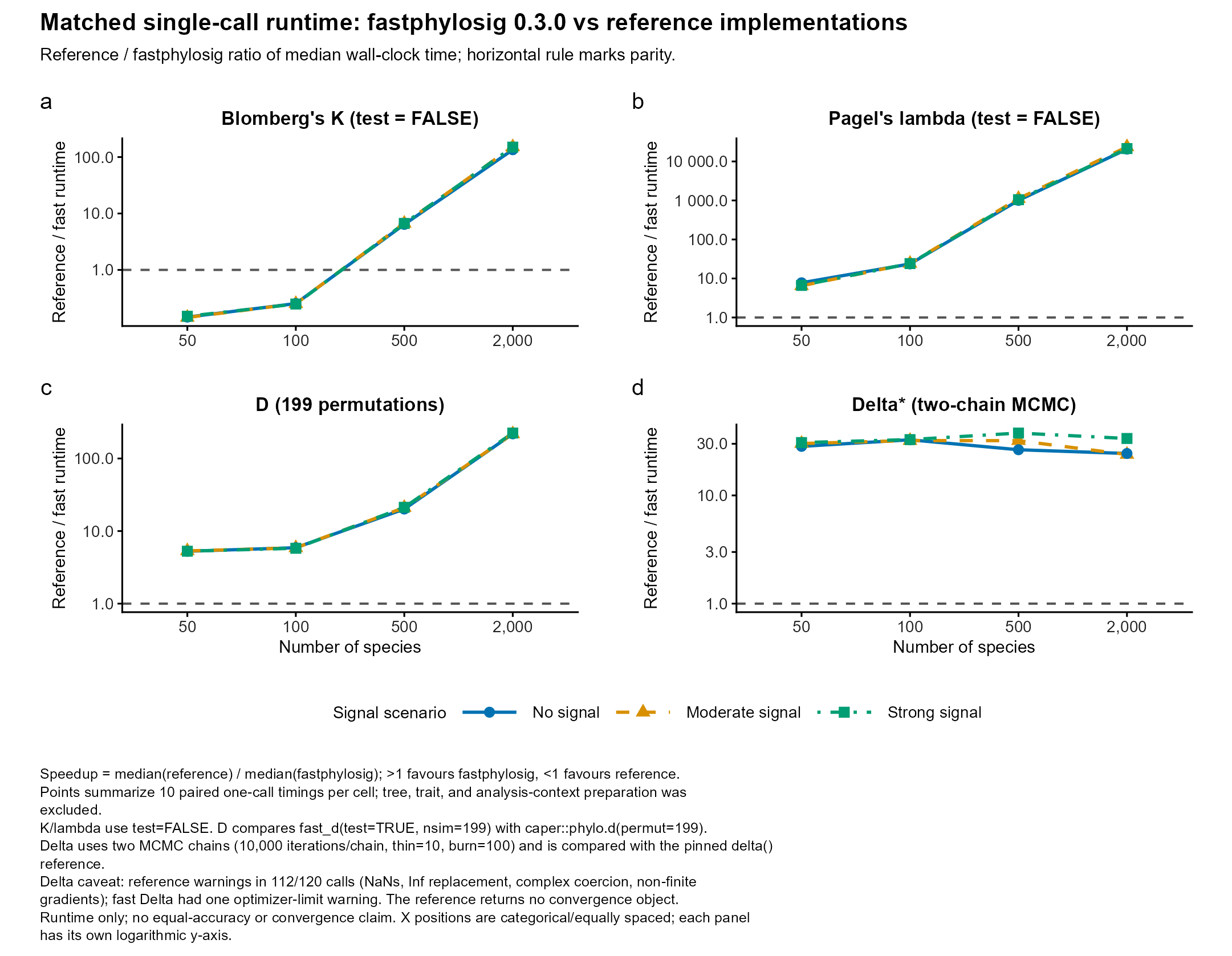
Ratios are reference median time ÷ fastphylosig median time, so a value above 1 means fastphylosig was faster. The references are phytools 2.5.2 for K and lambda, caper for D, and the published Borges (2019) code for Delta. Each range covers three designed signal scenarios (Brownian/noise mixtures with weights 0, 0.5 and 0.95).
The v0.3.5 release is the latest version. It provides the full clade-scale workflow and improves D/lambda performance.
install.packages(
  "https://github.com/yinwen-ecology/fastphylosig/releases/download/v0.3.5/fastphylosig_0.3.5.tar.gz",
  repos = NULL, type = "source"
)
library(fastphylosig)
Source installation needs a C++17 toolchain and, on Windows, Rtools. It also requires ape, Rcpp and RcppArmadillo.
Simulated example data
set.seed(1)
tree <- ape::rtree(30)
trait <- setNames(stats::rnorm(30), tree$tip.label)
binary <- setNames(as.integer(trait > stats::median(trait)), tree$tip.label)
state <- setNames(sample(letters[1:3], 30, replace = TRUE), tree$tip.label)
K
k <- fast_signal(tree, data = trait, method = "K",
                 test = TRUE, nsim = 999,
                 return_sim = TRUE, progress = FALSE)
lambda
lambda <- fast_signal(tree, data = trait, method = "lambda",
                      test = TRUE, progress = FALSE)
D
d <- fast_signal(tree, data = binary, method = "D",
                 test = TRUE, nsim = 999,
                 return_sim = TRUE, progress = FALSE)
Delta
delta <- fast_signal(tree, data = state, method = "Delta",
                     test = TRUE, nsim = 199, progress = FALSE)
fast_signal() combines tree checking, tree–trait matching, missing-value handling and signal calculation. If needed, the four steps can also be run separately.
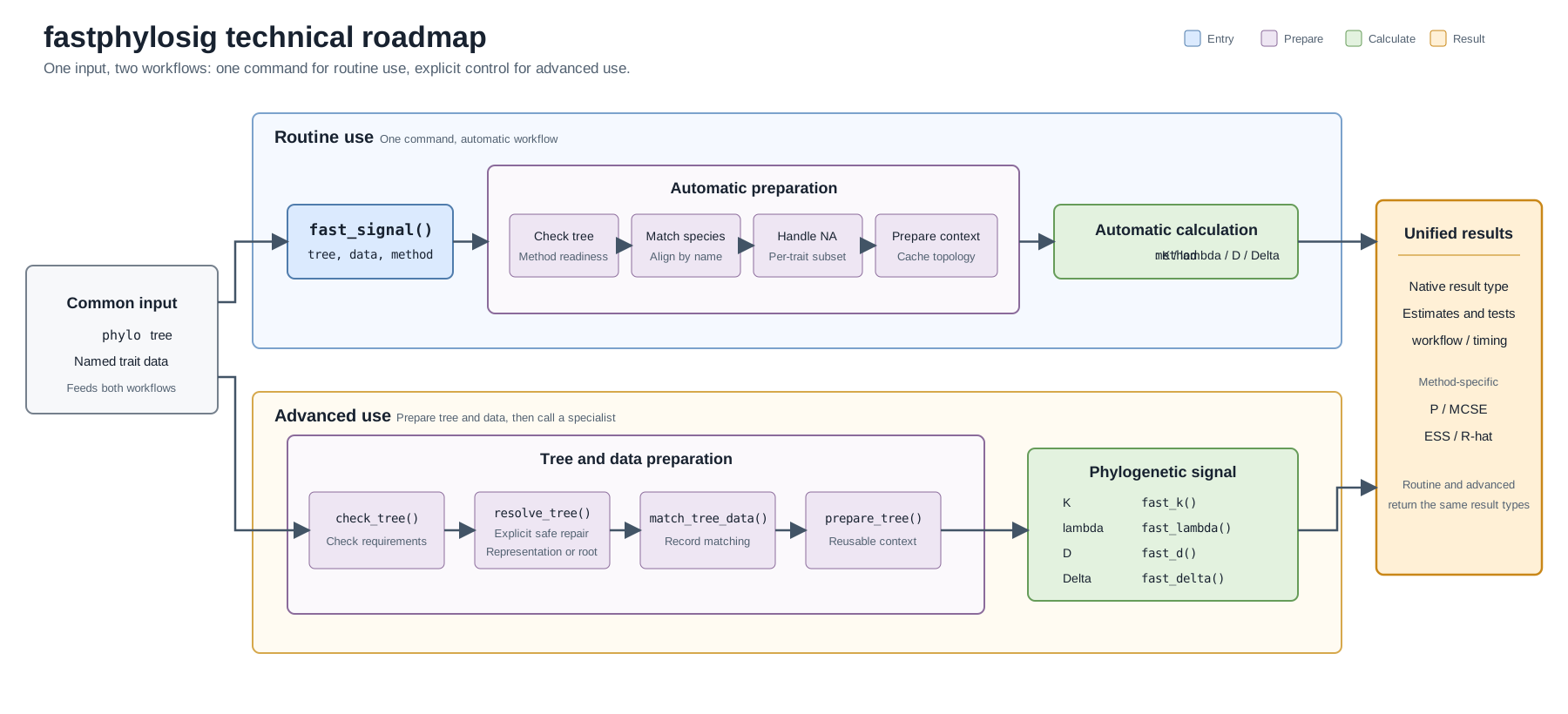
checked <- check_tree(tree, signal = "K")
tree_ready <- resolve_tree(tree, signal = "K")
matched <- match_tree_data(tree_ready, data = trait)
ctx <- prepare_tree(matched$tree)

k <- fast_k(ctx, x = matched$data, test = TRUE, nsim = 999,
            progress = FALSE)
See the Chinese usage guide and the complete v0.3.0 examples.
K and lambda are compared with phytools 2.5.2 phylosig(), D with caper 1.0.4 phylo.d(), and Delta with the published Borges (2019) code. Trees of 50 to 2,000 tips, three signal scenarios, and 10 paired replicates per setting (20 timed calls). Timing starts after tree and data preparation.
plot_signalPlots from simulated data.
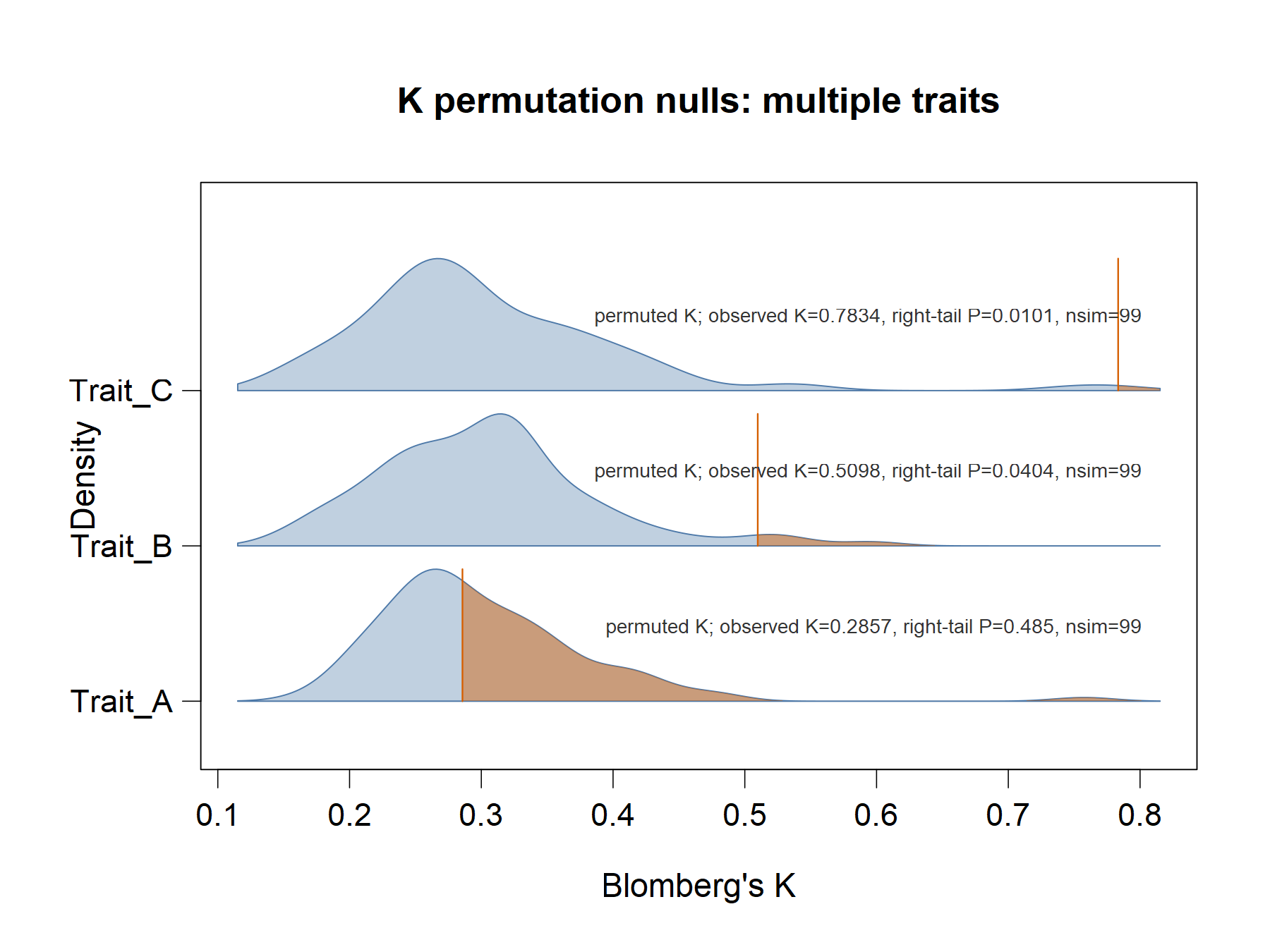
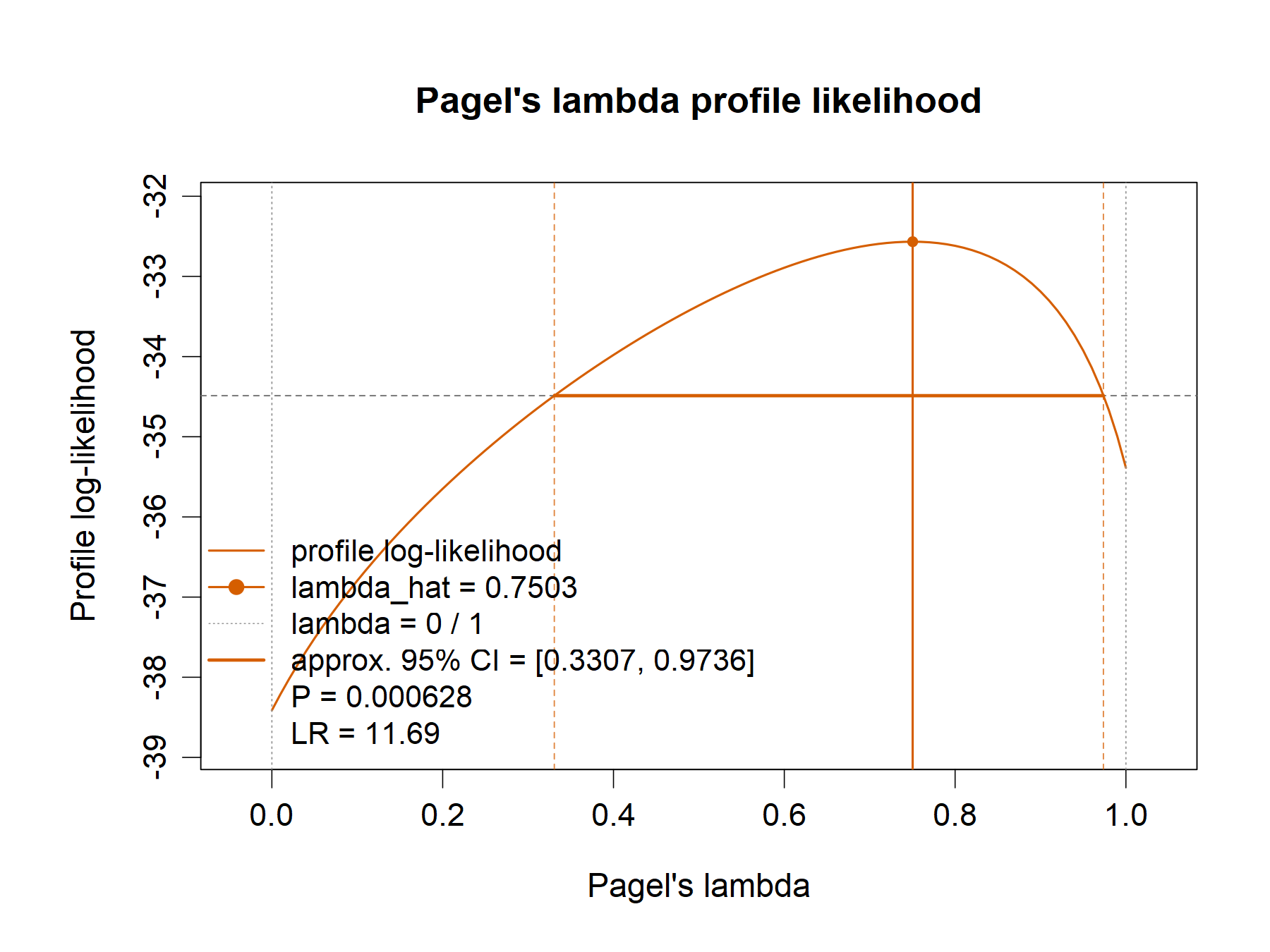
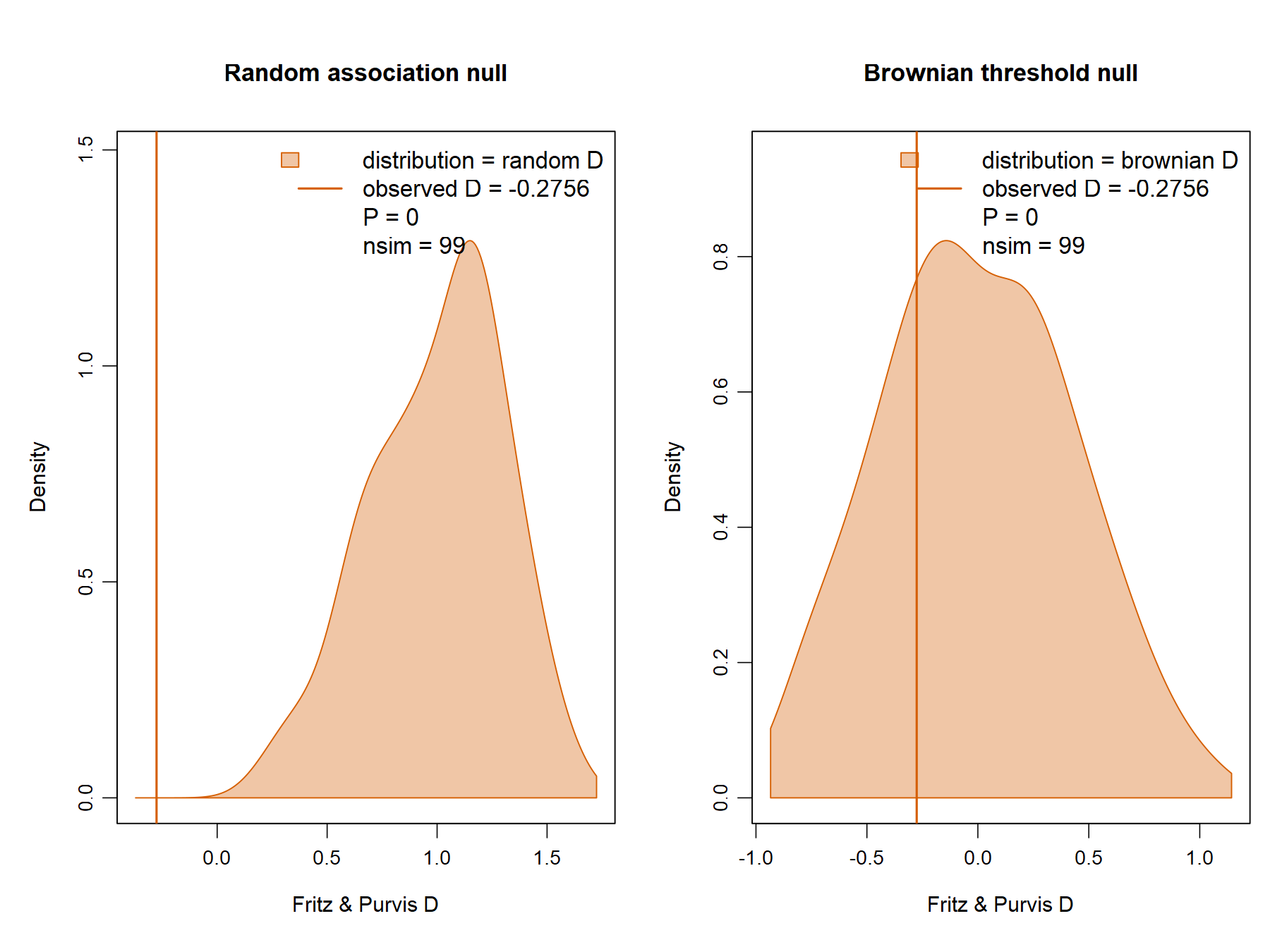
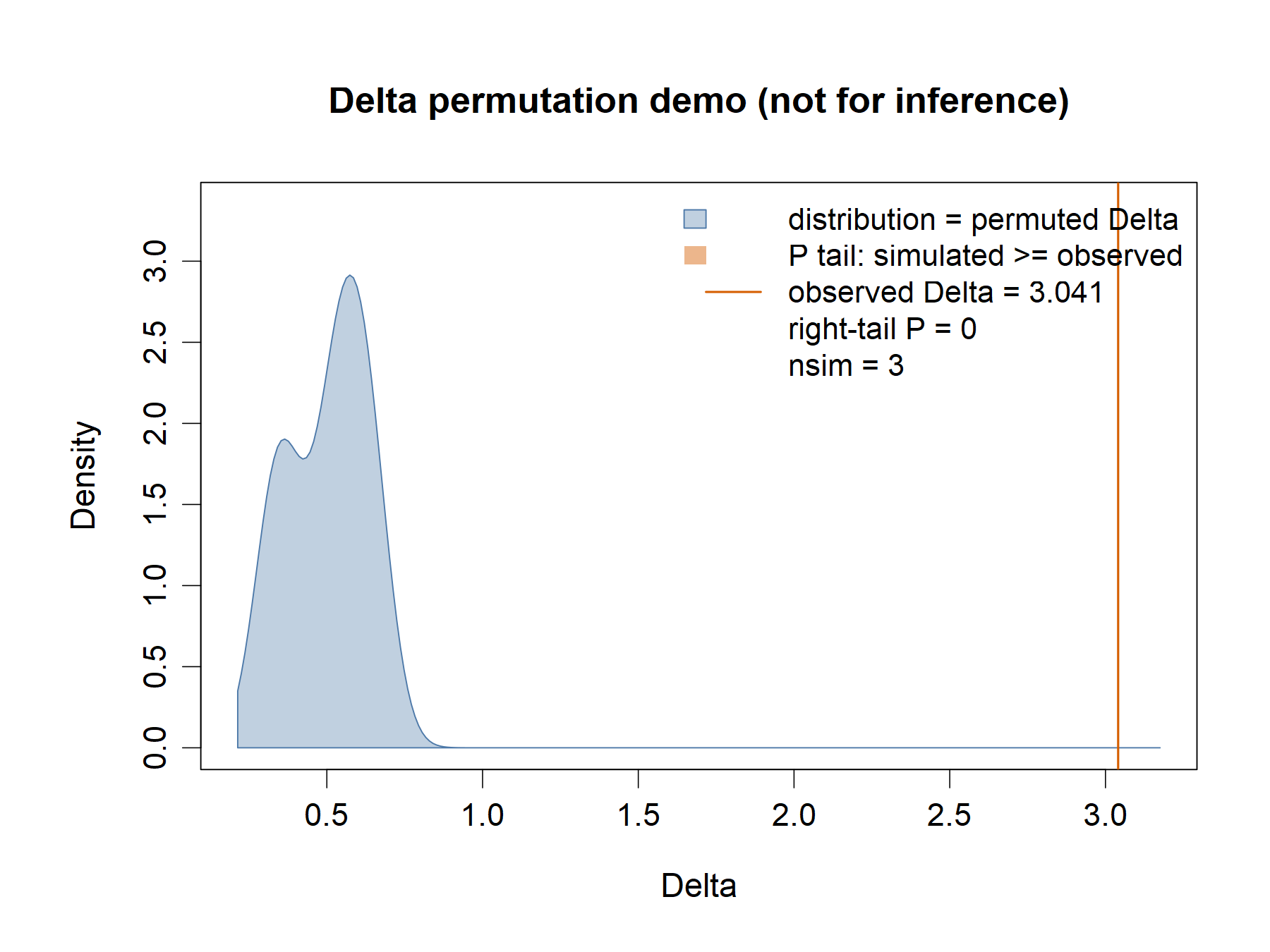
View all six plot styles and the Delta demo
fast_hetero()In a large tree (say more than 1,000 tips), a single signal value cannot describe how lineages differ: some clades may be more conserved, others more labile. I developed fast_hetero() to split the tree into crown clades (a node and all its descendants), estimate signal for each, and set the local estimates beside the whole-tree value. You can name the clades yourself, or let the function choose the largest non-overlapping clades within a size range. Results keep the real sample size of each clade, its missing observations, its state composition and its fit and MCMC diagnostics.
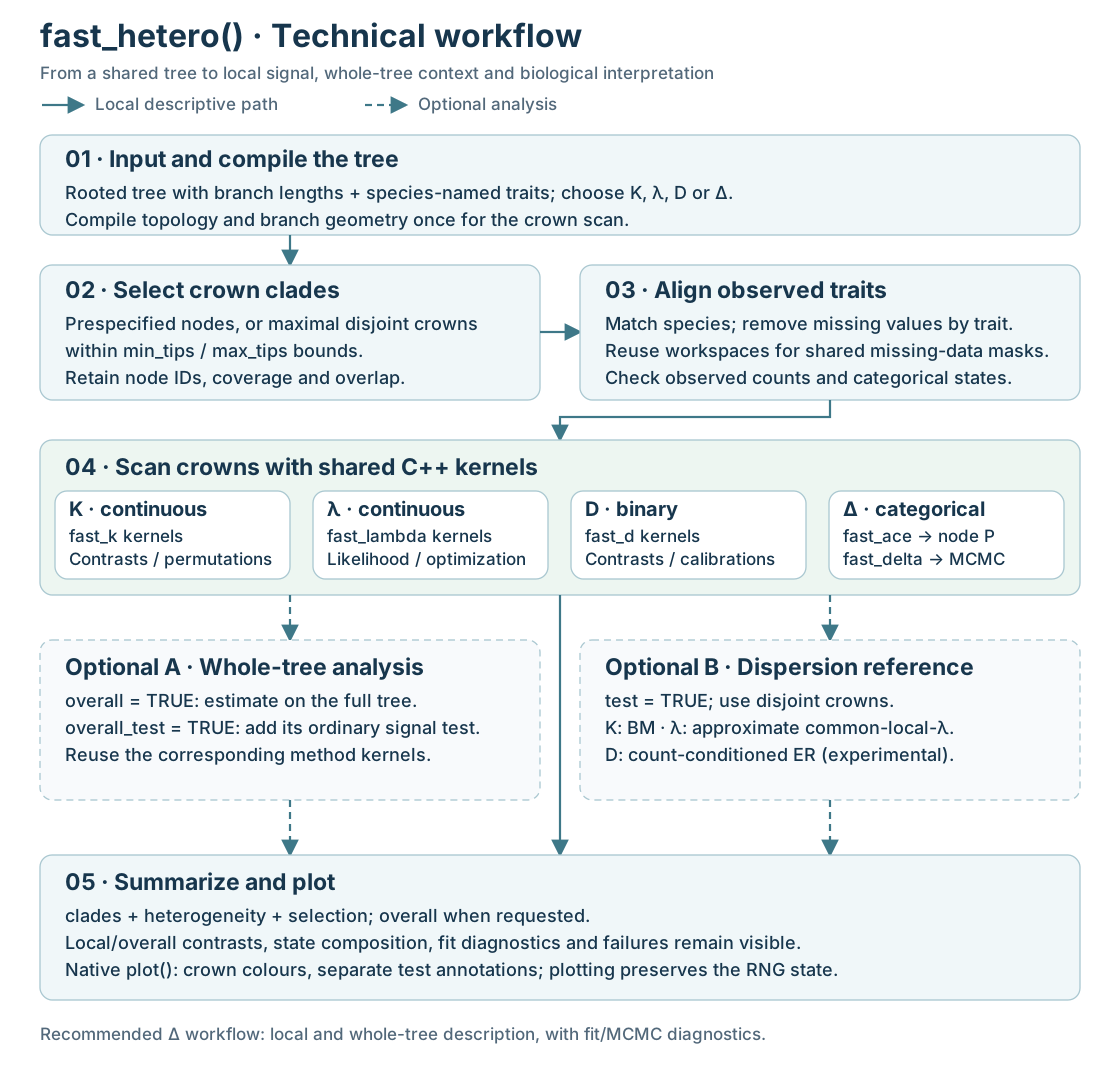
fast_hetero() workflow: select crowns, reuse the method kernels, then combine local estimates, optional whole-tree analysis and diagnostics. Follow the workflow in the case study · 中文路线图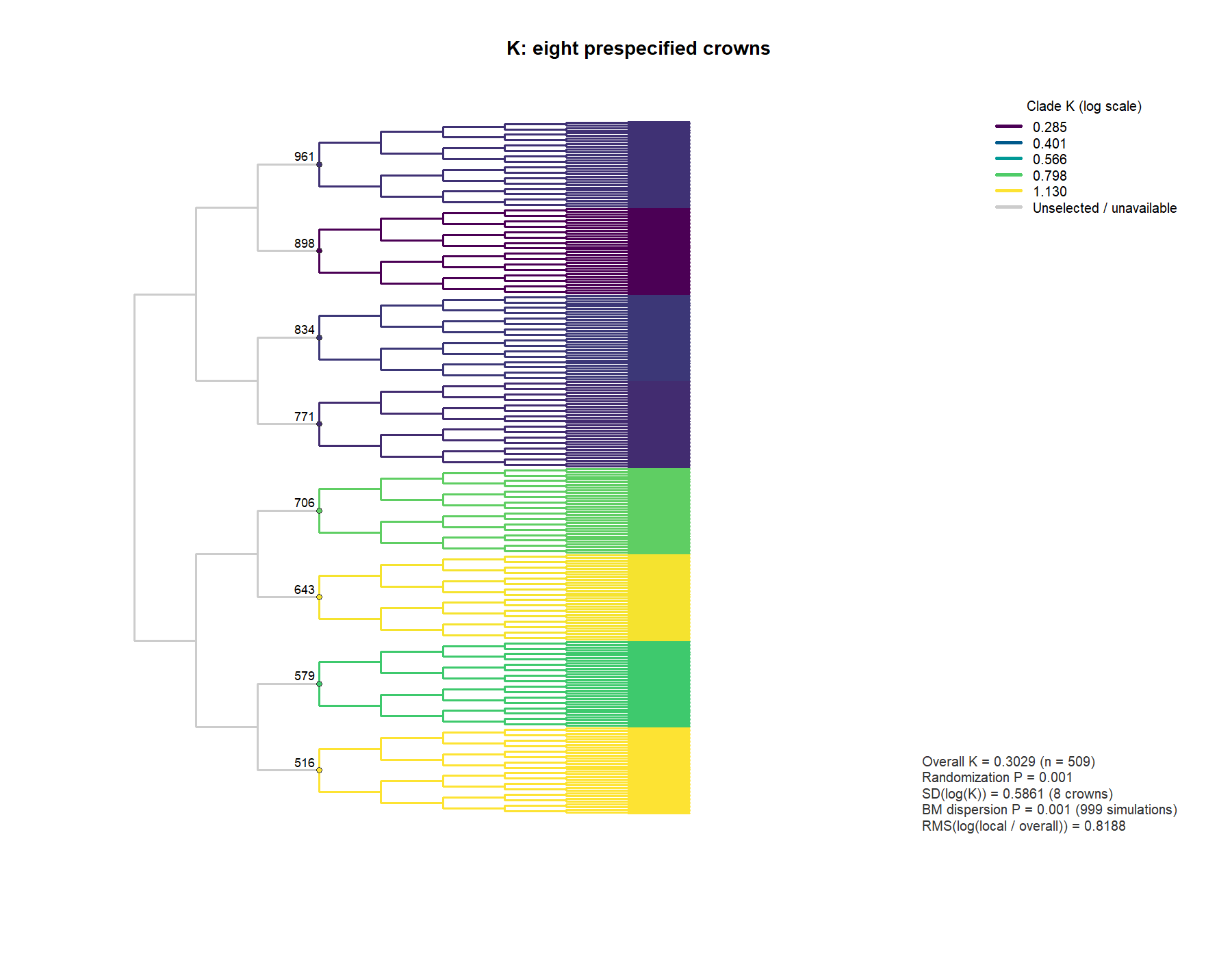
plot() output from the case study; numbers, diagnostics, code and data are on the case page.Delta ratios compare returned calls, not accuracy. The reference emitted numerical warnings in 112 of 120 calls and exposes no final convergence check, and one fast call reached its optimizer limit. No warned call was removed or re-run, so these ratios do not show that the two implementations are equally accurate or equally converged. Warnings are retained in the raw timed-call records, with counts by type in the benchmark QA report.
The current release is fastphylosig v0.3.5. The runtime figures above come from v0.3.0 and were not re-run for v0.3.4, because the core computational code did not change. See the release notes and the fast_hetero case study.